"Speak for it Charlotte"
Many years before I was ordained and given the name Aryanisha, I was just a little girl struggling to speak.
My older sister Vicky told Mum what I wanted instead - with the kind of spidey-sense you develop as kids.
I also had a lisp but generally remember myself as reasonably confident. The lisp disappeared but I still fumble on my words at times - it's easy to spot in the captions for my social media videos.
We were home educated for two years - a period in which I thrived. I loved learning and Mum was a brilliant teacher.
"Mum, can I have more sums?" I would ask in the morning.
After my parents separated, we moved and I went back into mainstream school when I was 8. That's when the bullying began.
I'm pleased there's so much being done around social mobility these days, but you'll never hear me say I'm state-school and proud.
I'm "state-school and survived", for sure. Grateful for the teachers I had.
It was, however, unbelievably tough to be smart in that environment.
I tried to keep my head down in primary and secondary school, but it's hard to be invisible when you're clearly getting better results.
Teachers Pet. Swot. Goody two-shoes. The usual name-calling.
I remember Jessica, who simply ripped up my work one day in a spiteful power move.
During my first few months of secondary school, I was asked to read a poem in assembly. The lights burned down into my skin. I was visibly nervous and the other kids could tell - pointing out loudly that I was shaking, which made the paper move too.
It's my first clear memory of public speaking humiliation. I was 11.
Into my teens, I wanted something more than that small town, with its small minded people, could offer. So there was no question of not doing well.
The threat increased though. I was never physically beaten up, but I knew another boy who was and he moved schools, which put me on edge all the time.
A well-meaning government initiative was introduced called "Gifted and Talented" - as if I needed a target more clearly painted onto my back.
It's only in hindsight that I can see the damage of those years.
Still, something in me wouldn't be crushed. The bullies left at the end of our GCSEs - I got all A*s and can still remember the feeling as I read the results.
I set my sights on Oxbridge. No one had been from my school - only one had ever applied. I was encouraged by a couple of outreach events, those good teachers who believed in me and my friend Ollie, who applied to Oxford.
Despite one family member condescendingly saying "This one thinks she's going to Oxbridge" to a shop assistant, and other odds stacked against me, I applied to Cambridge and got in.
The shift was huge.
I went from being one of the top students in my school to desperately trying to keep up. I studied Politics, Psychology and Sociology - with a fair amount of Anthropology thrown in there too. I loved it but my god was it hard.
It was a sharp change from worrying about people knowing I was smart, to worrying people would think I wasn't smart enough. I don't think my nervous system could quite keep up.
I never used to put my hand up in lectures. Just the idea of it had me feeling shaky and blushing.
Ah yes. The blushing. As much as I tried for years not to look nervous - by controlling my hand movements, posture and voice - I just couldn't prevent the blushing. Like, bright red blushing if I even considered becoming the centre of attention.
At some point in second year, I had the self-awareness to realise I needed to start getting outside of my comfort zone with public speaking. Otherwise I would watch everyone fly past me. Including the people - mostly guys - who were quick to spout off their poorly thought through opinions with conviction. That frustrated me the most.
So I put myself up for Women's Officer at my College (Pembroke) and got the role. I may have been the only candidate but it was a start. A year later, I even ran for a university-wide sabbatical post - an election I would never dreamed of participating in before Cambridge.
There was a big problem I didn't spot at the time - a bad habit developed during this period.
The only way I knew how to be visible was to force myself into something that was hard to back out of, and then try to fake as much confidence as possible, even though I was terrified inside.
That habit lasted for quite a few years after Cambridge - moving to India for a year at 22 and then becoming a consultant for international businesses on ethical supply chains, back in London at 23.
I knew how to put on a mask and wear the right armour. I bought nice clothes, got an expensive haircut, and spent as much as I could on a decent pair of leather boots. I power walked around the City as if I owned it. I shifted my accent, studied other leaders. I was an expert at faking it.
I had become a swan. Gliding along on the surface - making it all look easy as I swished into glass high-rise offices for important meetings with business execs.
Underneath, I was desperately trying to keep up.
My anxiety levels went through the roof and I started seeing a counsellor.
Before I went to India at 22, I came across an international Buddhist group that had a centre in Cambridge. When I returned to London in 2013, I started attending the London Buddhist Centre in Bethnal Green.
Like many women, learning to meditate didn't make me feel calm. In fact, it was then that I started having panic attacks for the first time. Meditation held up a mirror to the fear and overwhelm lurking just below the surface.
I met my therapist - a member of the Buddhist Order I now belong to - and during those sessions we often talked about Shiny Charlotte - the version I became most of the time at work and the Buddhist Centre.
That was when I really began transforming the deeper patterns of my mind. I asked for Ordination in 2014 and started what would be, for me, a seven year training process.
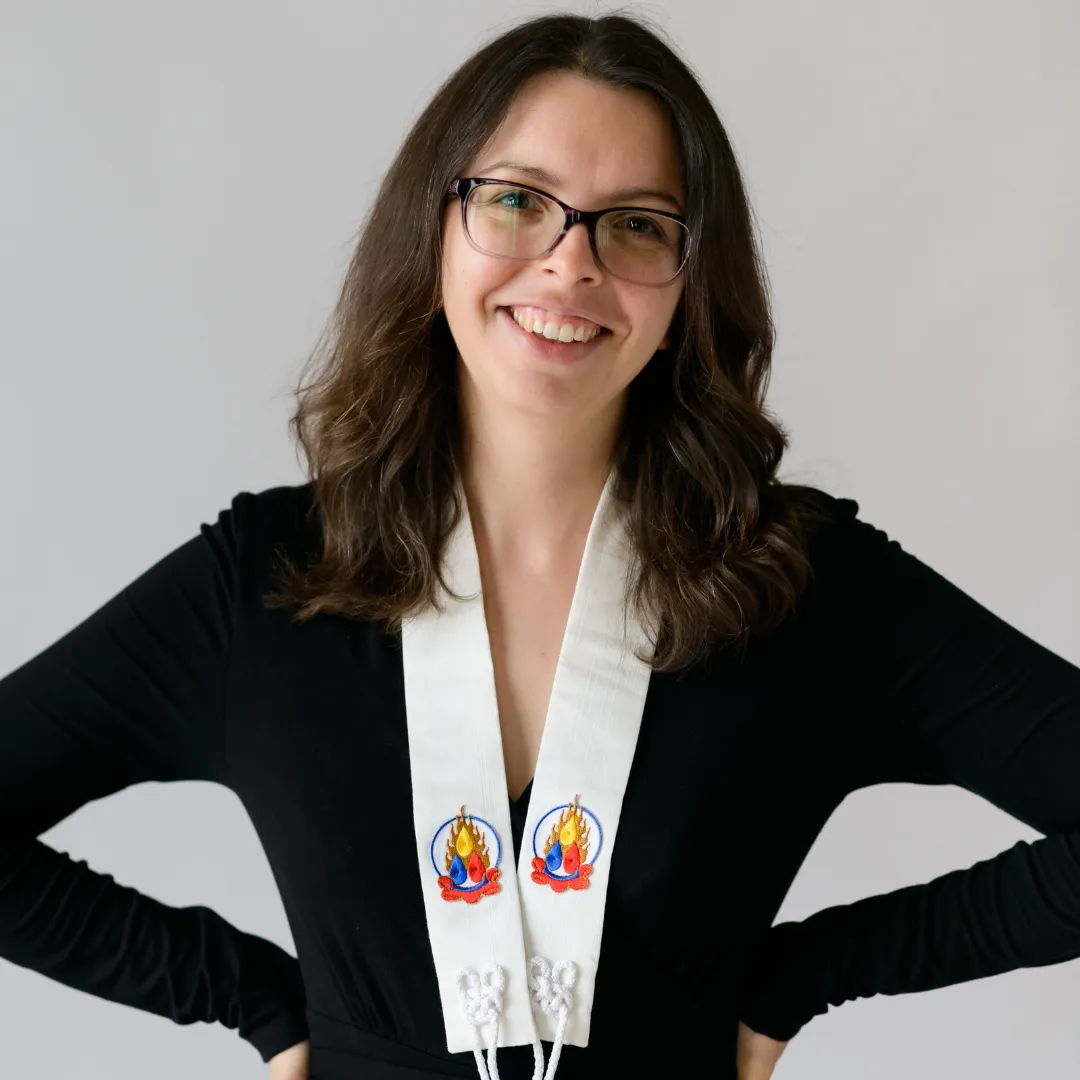
I was Ordained in 2021, and given this name which means "She whose dream is of the Noble Ones."
Ordination is many things. For me, one of the most important aspects is the commitment and effort to transform your mental states, communication and behaviour so they become more in line with our core values.
These are the 10 precepts in brief:
Abstaining from taking life | Counterpart: Practicing loving-kindness
Abstaining from taking the not-given (stealing) | Counterpart: Practicing open-handed generosity
Abstaining from sexual misconduct | Counterpart: Practicing stillness, simplicity, and contentment
Abstaining from false speech | Counterpart: Practicing truthful communication
Abstaining from harsh speech | Counterpart: Practicing kindly speech
Abstaining from frivolous speech | Counterpart: Practicing meaningful speech
Abstaining from slanderous speech | Counterpart: Practicing harmonious speech
Abstaining from covetousness | Counterpart: Practicing tranquility
Abstaining from hatred | Counterpart: Practicing compassion
Abstaining from false views | Counterpart: Practicing wisdom
As you can imagine, it's incredibly difficult to stay loyal to these. I break them every day. Still , they're very precious to me.
Importantly, the ordination training process teaches you methods for training your mind consistently in this direction. Mindfulness is a key part of that.
How are you meant to stick to your values if you aren't even aware of what you're doing in the moment?
Self-compassion and encouragement from others is also needed. When you're already hyperaware of your many failings, this intensive looking inward can just exacerbate the "not good enough" stories.
During those years, public speaking was a normal part of my week. I had plenty to do at work - leading client calls - and would often be asked to give a short personal talk or announcement at the packed Buddhist Centre. As I became more experienced in both spheres, I took on more.
The inner work helped a lot. I genuinely started to build confidence from the inside out.
After Ordination, however, I had a rocky period and that took a huge hit. I was also burnt out professionally, after moving into emotionally demanding - and at times distressing - work supporting vulnerable adults and children in London.
Just before this big friendship drama, I had decided to leave work and set up my own business as a coach.
When I most needed to believe in myself, my confidence was at an all time low.
I wish I could tell you I'm exaggerating, but genuinely I had about 12-18 months when I cried or wanted to cry every single day. I also felt a lot of anger towards some friends I'd fallen out with.
What a time to be building my social media presence!
Then - because the universe has a dark sense of humour - my Dad was diagnosed with Stage 4 lung cancer in August 2024. He died 6 months later, and 4 weeks after that I led his funeral.
That season broke my heart in a way I didn't know was possible. But it was a breaking open that benefited me on a deeper level.
After the friendship fall outs and that - I just don't think there was much left to break anymore.
It took me some time to emerge from it - which included getting a spaniel puppy in summer 2025. What a blast that's been!
Little by little I've built my confidence back up from the inside. I feel very different now, like I used a stronger material this time around after losing so much.
Along side that, I've had the most incredible clients. It's probably marketing - but sometimes it's just felt like serendipity. Helping them build themselves back up too is such a privilege.
Because confidence isn't linear. There are some very sweet posts on Instagram about how it's a by-product of experience and repetition. But when this isn't your first rodeo, you know that's not true.
Life can be hard and cruel. You lose parts of yourself along the way. You can't just get them back. You have to become something new, something different.
And sometimes there are very real costs of being visible, of speaking up, of saying no and pointing out where harm is being caused.
I know that from professional and personal experience.
Those experiences wear you down. They can harden you beyond recognition, in an attempt to shield your heart from life's disappointments, betrayals and your own shortcomings.
If I've learnt anything, in my own f*ck ups and winter seasons, it's the need to dig deep for a stronger source of motivation, energy and inspiration. One that's less brittle than social approval or even making a difference. Relying on anything you can't control outside of yourself will always end in tears.
I make no claims to being brave, to having this all sorted. I am certainly not the most polished public speaker either. Far from it. But I've heard from others that I'm a powerful one in my own way and that's good enough for me.
What I hope I can offer you, more than anything, is the companionship, perspective and humility of another female founder and leader who's gone through some tough stuff too.
"Speak for it Charlotte"
Many years before I was ordained and given the name Aryanisha, I was just a little girl struggling to speak.
My older sister Vicky told Mum what I wanted instead - with the kind of spidey-sense you develop as kids.
I also had a lisp but generally remember myself as reasonably confident. The lisp disappeared but I still fumble on my words at times - it's easy to spot in the captions for my social media videos.
We were home educated for two years - a period in which I thrived. I loved learning and Mum was a brilliant teacher.
"Mum, can I have more sums?" I would ask in the morning.
After my parents separated, we moved and I went back into mainstream school when I was 8. That's when the bullying began.
I'm pleased there's so much being done around social mobility these days, but you'll never hear me say I'm state-school and proud.
I'm "state-school and survived", for sure. Grateful for the teachers I had.
It was, however, unbelievably tough to be smart in that environment.
I tried to keep my head down in primary and secondary school, but it's hard to be invisible when you're clearly getting better results.
Teachers Pet. Swot. Goody two-shoes. The usual name-calling.
I remember Jessica, who simply ripped up my work one day in a spiteful power move.
During my first few months of secondary school, I was asked to read a poem in assembly. The lights burned down into my skin. I was visibly nervous and the other kids could tell - pointing out loudly that I was shaking, which made the paper move too.
It's my first clear memory of public speaking humiliation. I was 11.
Into my teens, I wanted something more than that small town, with its small minded people, could offer. So there was no question of not doing well.
The threat increased though. I was never physically beaten up, but I knew another boy who was and he moved schools, which put me on edge all the time.
A well-meaning government initiative was introduced called "Gifted and Talented" - as if I needed a target more clearly painted onto my back.
It's only in hindsight that I can see the damage of those years.
Still, something in me wouldn't be crushed. The bullies left at the end of our GCSEs - I got all A*s and can still remember the feeling as I read the results.
I set my sights on Oxbridge. No one had been from my school - only one had ever applied. I was encouraged by a couple of outreach events, those good teachers who believed in me and my friend Ollie, who applied to Oxford.
Despite one family member condescendingly saying "This one thinks she's going to Oxbridge" to a shop assistant, and other odds stacked against me, I applied to Cambridge and got in.
The shift was huge.
I went from being one of the top students in my school to desperately trying to keep up. I studied Politics, Psychology and Sociology - with a fair amount of Anthropology thrown in there too. I loved it but my god was it hard.
It was a sharp change from worrying about people knowing I was smart, to worrying people would think I wasn't smart enough. I don't think my nervous system could quite keep up.
I never used to put my hand up in lectures. Just the idea of it had me feeling shaky and blushing.
Ah yes. The blushing. As much as I tried for years not to look nervous - by controlling my hand movements, posture and voice - I just couldn't prevent the blushing. Like, bright red blushing if I even considered becoming the centre of attention.
At some point in second year, I had the self-awareness to realise I needed to start getting outside of my comfort zone with public speaking. Otherwise I would watch everyone fly past me. Including the people - mostly guys - who were quick to spout off their poorly thought through opinions with conviction. That frustrated me the most.
So I put myself up for Women's Officer at my College (Pembroke) and got the role. I may have been the only candidate but it was a start. A year later, I even ran for a university-wide sabbatical post - an election I would never dreamed of participating in before Cambridge.
There was a big problem I didn't spot at the time - a bad habit developed during this period.
The only way I knew how to be visible was to force myself into something that was hard to back out of, and then try to fake as much confidence as possible, even though I was terrified inside.
That habit lasted for quite a few years after Cambridge - moving to India for a year at 22 and then becoming a consultant for international businesses on ethical supply chains, back in London at 23.
I knew how to put on a mask and wear the right armour. I bought nice clothes, got an expensive haircut, and spent as much as I could on a decent pair of leather boots. I power walked around the City as if I owned it. I shifted my accent, studied other leaders. I was an expert at faking it.
I had become a swan. Gliding along on the surface - making it all look easy as I swished into glass high-rise offices for important meetings with business execs.
Underneath, I was desperately trying to keep up.
My anxiety levels went through the roof and I started seeing a counsellor.
Before I went to India at 22, I came across an international Buddhist group that had a centre in Cambridge. When I returned to London in 2013, I started attending the London Buddhist Centre in Bethnal Green.
Like many women, learning to meditate didn't make me feel calm. In fact, it was then that I started having panic attacks for the first time. Meditation held up a mirror to the fear and overwhelm lurking just below the surface.
I met my therapist - a member of the Buddhist Order I now belong to - and during those sessions we often talked about Shiny Charlotte - the version I became most of the time at work and the Buddhist Centre.
That was when I really began transforming the deeper patterns of my mind. I asked for Ordination in 2014 and started what would be, for me, a seven year training process.
I was Ordained in 2021, and given this name which means "She whose dream is of the Noble Ones."
Ordination is many things. For me, one of the most important aspects is the commitment and effort to transform your mental states, communication and behaviour so they become more in line with our core values.
These are the 10 precepts in brief:
Abstaining from taking life | Counterpart: Practicing loving-kindness
Abstaining from taking the not-given (stealing) | Counterpart: Practicing open-handed generosity
Abstaining from sexual misconduct | Counterpart: Practicing stillness, simplicity, and contentment
Abstaining from false speech | Counterpart: Practicing truthful communication
Abstaining from harsh speech | Counterpart: Practicing kindly speech
Abstaining from frivolous speech | Counterpart: Practicing meaningful speech
Abstaining from slanderous speech | Counterpart: Practicing harmonious speech
Abstaining from covetousness | Counterpart: Practicing tranquility
Abstaining from hatred | Counterpart: Practicing compassion
Abstaining from false views | Counterpart: Practicing wisdom
As you can imagine, it's incredibly difficult to stay loyal to these. I break them every day. Still , they're very precious to me.
Importantly, the ordination training process teaches you methods for training your mind consistently in this direction. Mindfulness is a key part of that.
How are you meant to stick to your values if you aren't even aware of what you're doing in the moment?
Self-compassion and encouragement from others is also needed. When you're already hyperaware of your many failings, this intensive looking inward can just exacerbate the "not good enough" stories.
During those years, public speaking was a normal part of my week. I had plenty to do at work - leading client calls - and would often be asked to give a short personal talk or announcement at the packed Buddhist Centre. As I became more experienced in both spheres, I took on more.
The inner work helped a lot. I genuinely started to build confidence from the inside out.
After Ordination, however, I had a rocky period and that took a huge hit. I was also burnt out professionally, after moving into emotionally demanding - and at times distressing - work supporting vulnerable adults and children in London.
Just before this big friendship drama, I had decided to leave work and set up my own business as a coach.
When I most needed to believe in myself, my confidence was at an all time low.
I wish I could tell you I'm exaggerating, but genuinely I had about 12-18 months when I cried or wanted to cry every single day. I also felt a lot of anger towards some friends I'd fallen out with.
What a time to be building my social media presence!
Then - because the universe has a dark sense of humour - my Dad was diagnosed with Stage 4 lung cancer in August 2024. He died 6 months later, and 4 weeks after that I led his funeral.
That season broke my heart in a way I didn't know was possible. But it was a breaking open that benefited me on a deeper level.
After the friendship fall outs and that - I just don't think there was much left to break anymore.
It took me some time to emerge from it - which included getting a spaniel puppy in summer 2025. What a blast that's been!
Little by little I've built my confidence back up from the inside. I feel very different now, like I used a stronger material this time around after losing so much.
Along side that, I've had the most incredible clients. It's probably marketing - but sometimes it's just felt like serendipity. Helping them build themselves back up too is such a privilege.
Because confidence isn't linear. There are some very sweet posts on Instagram about how it's a by-product of experience and repetition. But when this isn't your first rodeo, you know that's not true.
Life can be hard and cruel. You lose parts of yourself along the way. You can't just get them back. You have to become something new, something different.
And sometimes there are very real costs of being visible, of speaking up, of saying no and pointing out where harm is being caused.
I know that from professional and personal experience.
Those experiences wear you down. They can harden you beyond recognition, in an attempt to shield your heart from life's disappointments, betrayals and your own shortcomings.
If I've learnt anything, in my own f*ck ups and winter seasons, it's the need to dig deep for a stronger source of motivation, energy and inspiration. One that's less brittle than social approval or even making a difference. Relying on anything you can't control outside of yourself will always end in tears.
I make no claims to being brave, to having this all sorted. I am certainly not the most polished public speaker either. Far from it. But I've heard from others that I'm a powerful one in my own way and that's good enough for me.
What I hope I can offer you, more than anything, is the companionship, perspective and humility of another female founder and leader who's gone through some tough stuff too.